

The relationship between traditional finance and cryptocurrency has always been complicated. For years, major banks criticized digital assets while crypto advocates accused financial institutions of resisting innovation. However, as Bitcoin adoption continues to rise globally, many banks now want exposure to the same market they once dismissed. That dramatic shift has sparked strong reactions across the crypto industry. Recently, Eric Trump rejects JPMorgan’s bitcoin credibility became a major talking point after his criticism of the banking giant’s changing stance toward Bitcoin.
The debate reflects a much larger issue within the digital asset ecosystem. Investors now question whether institutions truly support decentralization or simply want to control the next financial revolution. At the same time, Wall Street firms continue expanding their crypto operations because demand from retail and institutional investors keeps increasing. Consequently, the tension between traditional finance and cryptocurrency has intensified.
Bitcoin has evolved from a niche experiment into a global financial asset. Governments, hedge funds, and corporations now treat it seriously. Nevertheless, many crypto supporters remain skeptical of large banks that previously attacked the industry. That skepticism explains why the statement that Eric Trump rejects JPMorgan’s bitcoin credibility gained significant attention among crypto enthusiasts.
This article explores the controversy in detail. It also examines the evolving relationship between Bitcoin and traditional banking institutions, institutional crypto adoption, investor trust, and the future of digital finance.
Why Eric Trump Criticized JPMorgan
The controversy started after renewed discussions surrounding JPMorgan’s involvement in cryptocurrency markets. Over the years, the banking giant has shown mixed opinions about Bitcoin. On one hand, executives previously warned investors about crypto risks. On the other hand, the bank gradually expanded blockchain initiatives and digital asset services.
As a result, critics accused the bank of hypocrisy. According to reports and public reactions online, Eric Trump rejects JPMorgan’s bitcoin credibility because he believes Wall Street institutions spent years undermining Bitcoin before trying to profit from it later.
Many crypto supporters share that frustration. They remember how banks once described Bitcoin as dangerous, speculative, or even worthless. However, once institutional demand increased and crypto markets matured, several major financial firms changed direction. Therefore, critics argue that banks now support Bitcoin only because they see enormous revenue opportunities.
Moreover, Trump’s comments resonated with retail investors who distrust centralized financial institutions. Bitcoin originally emerged as an alternative to the traditional banking system after the 2008 financial crisis. Consequently, many early adopters still believe banks oppose financial freedom and decentralization.
The phrase “institutional hypocrisy in crypto” has become increasingly common in discussions surrounding Wall Street’s evolving digital asset strategy. Supporters of decentralized finance argue that traditional banks want exposure to crypto while still maintaining centralized control over financial systems.
The Long History Between Wall Street and Bitcoin
To understand why Eric Trump rejects JPMorgan’s bitcoin credibility, it is important to examine the history between Bitcoin and traditional finance.
When Bitcoin first appeared in 2009, most financial institutions dismissed it entirely. Bank executives criticized cryptocurrency for lacking regulation, stability, and intrinsic value. Furthermore, governments expressed concerns about money laundering and illegal activity.
Despite those criticisms, Bitcoin survived multiple crashes and continued gaining adoption. Gradually, institutional attitudes started changing. Large corporations added Bitcoin to their balance sheets. Meanwhile, hedge funds began offering crypto investment products.
Eventually, Wall Street realized that digital assets represented a growing financial sector that could not be ignored. Therefore, banks slowly entered the market through custody services, trading desks, and blockchain research divisions.
This transition created confusion among investors. Some people welcomed institutional involvement because it increased legitimacy and liquidity. Others believed Wall Street’s participation threatened the decentralized philosophy behind cryptocurrency.
The conflict remains visible today. Every time a major bank changes its crypto position, critics highlight earlier statements that contradicted current actions. Consequently, the narrative surrounding institutional trust continues influencing public perception.
Bitcoin’s Growing Influence in Global Finance
Bitcoin is no longer viewed as a fringe technology. Instead, it has become a recognized global financial asset. Institutional investors, pension funds, and publicly traded companies now monitor Bitcoin prices alongside traditional markets.
The rapid growth of digital asset investment has transformed the financial landscape. Moreover, Bitcoin exchange-traded funds have opened new opportunities for mainstream investors. As a result, traditional finance institutions increasingly compete for crypto-related business.
This evolution explains why the statement Eric Trump rejects JPMorgan’s bitcoin credibility attracted attention across financial media and crypto communities. The controversy symbolizes a broader struggle between decentralized finance advocates and established banking institutions.
Furthermore, Bitcoin’s role as a potential hedge against inflation has strengthened its appeal. Economic uncertainty, currency devaluation, and geopolitical instability continue pushing investors toward alternative assets. Therefore, institutional demand for Bitcoin may continue rising in the coming years.
At the same time, retail investors remain cautious about Wall Street’s intentions. Many believe banks want to dominate crypto markets while limiting the financial independence that decentralized currencies promise.
JPMorgan’s Changing Crypto Position
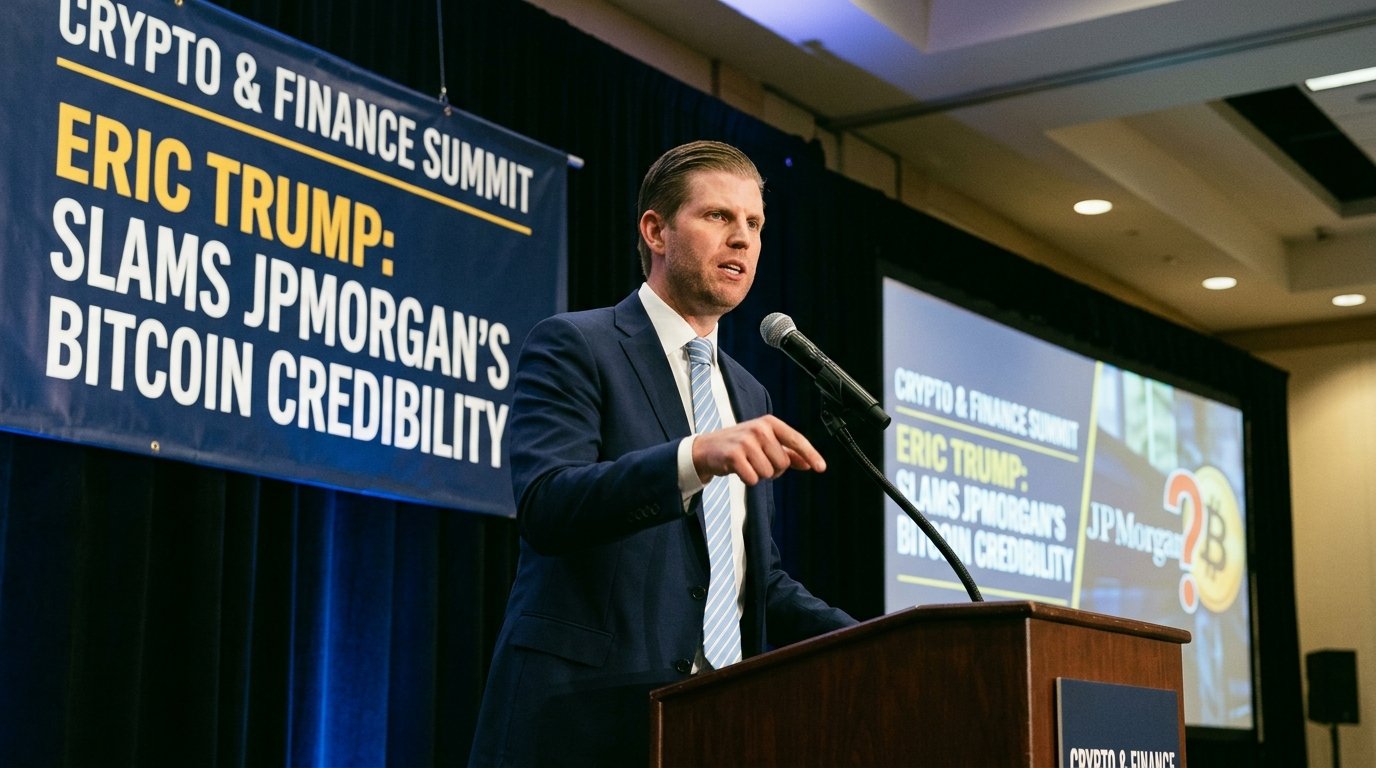
JPMorgan’s relationship with cryptocurrency has evolved significantly over time. Years ago, the bank’s leadership expressed serious skepticism about Bitcoin. Public criticism from executives created headlines worldwide. However, the bank later launched blockchain projects and explored crypto-related services.
That dramatic shift contributed to the reaction behind Eric Trump rejects JPMorgan’s bitcoin credibility. Critics argue that banks initially dismissed Bitcoin because they feared competition from decentralized financial systems.
As cryptocurrency markets matured, however, financial institutions recognized profitable opportunities. Consequently, several banks developed blockchain technology initiatives and digital asset investment products.
JPMorgan now participates in multiple blockchain and crypto-related ventures. Additionally, institutional clients increasingly request exposure to digital assets. Therefore, the bank cannot afford to ignore the industry’s growth.
Nevertheless, critics continue questioning whether institutional support for Bitcoin is genuine. Some analysts believe banks support blockchain technology while remaining uncomfortable with decentralized currencies themselves. Others argue that Wall Street simply follows market demand regardless of previous opinions.
The issue ultimately revolves around trust. Crypto communities value transparency and decentralization. Traditional banks, however, operate within centralized systems that prioritize regulation and institutional control.
Institutional Adoption Is Reshaping Crypto
The rise of institutional crypto adoption represents one of the biggest changes in modern finance. Large investment firms, banks, and corporations now allocate resources toward digital asset infrastructure.
This transformation affects market stability, liquidity, and public perception. Institutional participation has helped Bitcoin gain mainstream recognition. Additionally, major financial firms provide custody solutions and investment products that attract new investors.
However, the phrase Eric Trump rejects JPMorgan’s bitcoin credibility reflects concerns about whether institutional involvement aligns with crypto’s original purpose.
Some crypto advocates fear that banks could centralize aspects of the industry. Others believe institutional participation is necessary for broader adoption and regulatory acceptance.
The reality likely falls somewhere in between. Institutional investment increases legitimacy and accessibility. Yet decentralization supporters remain wary of concentrated financial power.
Moreover, institutional involvement influences market behavior. Large investors can significantly impact Bitcoin prices through massive transactions and strategic positioning. Consequently, retail traders often monitor institutional activity closely.
The Political Dimension of Bitcoin
Bitcoin has increasingly become a political issue. Politicians, business leaders, and public figures now discuss cryptocurrency in relation to financial freedom, regulation, and economic policy.
The statement Eric Trump rejects JPMorgan’s bitcoin credibility also reflects broader political narratives about distrust toward traditional financial institutions. Many crypto supporters believe centralized banking systems hold excessive power over economies and individuals.
Meanwhile, governments continue debating how to regulate digital assets. Some countries embrace cryptocurrency innovation, while others impose strict limitations. Regulatory uncertainty therefore remains a major challenge for the industry.
Political debates surrounding Bitcoin often focus on privacy, decentralization, inflation, and monetary policy. Supporters argue that Bitcoin offers protection against government-controlled currency systems. Critics, however, warn about volatility and regulatory risks.
As cryptocurrency adoption expands, political discussions will likely intensify. Financial institutions, governments, and crypto communities will continue competing to shape the future of digital finance.
How Retail Investors View Wall Street’s Crypto Pivot
Retail investors played a crucial role in Bitcoin’s early growth. Many individual traders invested in cryptocurrency long before institutions showed interest. Consequently, some retail investors resent Wall Street’s growing influence over the industry.
That sentiment helps explain the popularity of headlines like Eric Trump rejects JPMorgan’s bitcoin credibility. Many crypto enthusiasts feel validated when public figures criticize institutional inconsistency.
Retail investors often argue that banks initially tried to suppress cryptocurrency adoption. Now that Bitcoin has become profitable and mainstream, those same institutions want market control.
Social media discussions frequently highlight this perceived contradiction. Furthermore, crypto communities tend to reward individuals who challenge traditional finance narratives.
However, not all investors oppose institutional involvement. Some believe Wall Street participation improves market maturity and long-term stability. Institutional capital can reduce volatility and increase investor confidence over time.
Still, distrust toward major banks remains deeply rooted within crypto culture. Bitcoin’s original vision emphasized financial independence from centralized institutions. Therefore, skepticism toward banks continues influencing investor attitudes.
Bitcoin Credibility and Public Trust
Public trust remains one of the most important factors in cryptocurrency adoption. Investors want confidence that digital assets will remain secure, valuable, and widely accepted.
The debate surrounding Eric Trump rejects JPMorgan’s bitcoin credibility ultimately centers on trust and authenticity. Crypto communities value consistency. Therefore, they often criticize institutions that change positions after market conditions improve.
At the same time, evolving opinions are common in finance. Markets change rapidly, and institutions adapt to new realities. Bitcoin’s growth forced many financial firms to reconsider earlier assumptions.
Today, Bitcoin credibility has improved significantly compared to previous years. Institutional investment, regulatory progress, and mainstream awareness have strengthened market confidence. Nevertheless, debates about decentralization and institutional control remain unresolved.
The crypto industry continues balancing innovation with mainstream adoption. That balance will shape Bitcoin’s long-term future.
The Future of Bitcoin and Traditional Banks
The relationship between Bitcoin and traditional banking institutions will likely continue evolving. Banks cannot ignore digital assets because investor demand keeps growing. Meanwhile, crypto markets benefit from institutional infrastructure and broader accessibility.
However, tensions between decentralization and centralized finance will remain a defining issue. The statement Eric Trump rejects JPMorgan’s bitcoin credibility represents more than a simple criticism. It reflects ongoing concerns about institutional motives within the crypto ecosystem.
In the future, collaboration between banks and blockchain companies may become more common. Financial institutions increasingly explore tokenization, stablecoins, and blockchain-based payment systems.
Additionally, governments may develop clearer regulatory frameworks that encourage institutional participation while protecting investors. Regulatory clarity could accelerate mainstream crypto adoption significantly.
Still, Bitcoin supporters will continue defending decentralization principles. Many investors believe cryptocurrency should reduce dependence on traditional financial intermediaries rather than strengthen them.
The outcome of this debate will influence the next phase of digital finance innovation.
Conclusion
The controversy surrounding Eric Trump rejects JPMorgan’s bitcoin credibility highlights the growing tension between cryptocurrency advocates and traditional financial institutions. Bitcoin has evolved into a major global asset, forcing Wall Street to reconsider earlier skepticism. Nevertheless, many crypto supporters remain cautious about institutional motives.
JPMorgan’s shifting relationship with Bitcoin symbolizes a broader transformation occurring across global finance. Banks once criticized cryptocurrency aggressively, yet many now pursue crypto-related business opportunities. Consequently, debates about trust, decentralization, and institutional influence continue shaping the digital asset industry.
Bitcoin’s future will depend on how these competing forces evolve. Institutional adoption may drive mainstream acceptance and market growth. However, decentralization advocates will likely continue resisting excessive corporate control.
As cryptocurrency adoption expands worldwide, discussions about financial freedom, regulation, and institutional credibility will remain central to the industry. The clash between Wall Street and decentralized finance is far from over, and Bitcoin remains at the center of that global conversation.
FAQs
Q. What did Eric Trump say about JPMorgan and Bitcoin?
Eric Trump criticized JPMorgan’s credibility regarding Bitcoin because the bank previously expressed skepticism toward cryptocurrency before later expanding crypto-related services and investments.
Q. Why do crypto supporters distrust major banks?
Many crypto supporters believe traditional banks oppose decentralization and financial freedom. They also criticize banks for changing their stance on Bitcoin after institutional adoption increased.
Q. Is JPMorgan involved in cryptocurrency today?
Yes, JPMorgan participates in several blockchain and digital asset initiatives. The bank has explored crypto investment products, blockchain technology, and institutional digital asset services.
Q. Why is institutional Bitcoin adoption important?
Institutional adoption increases liquidity, mainstream recognition, and market stability. It also encourages broader investor participation and regulatory development within the crypto industry.
Q. Can Bitcoin coexist with traditional banking systems?
Yes, Bitcoin and traditional banking systems can coexist. However, tensions between decentralization and centralized finance will likely continue as cryptocurrency adoption grows worldwide.
