

The cryptocurrency industry has always been defined by volatility, rapid innovation, and shifting narratives. Over the past decade, companies like Coinbase have ridden massive waves of growth fueled by Bitcoin rallies, decentralized finance expansion, and institutional adoption. However, as the market enters a period of slower growth and reduced trading activity, the dynamics are changing dramatically.
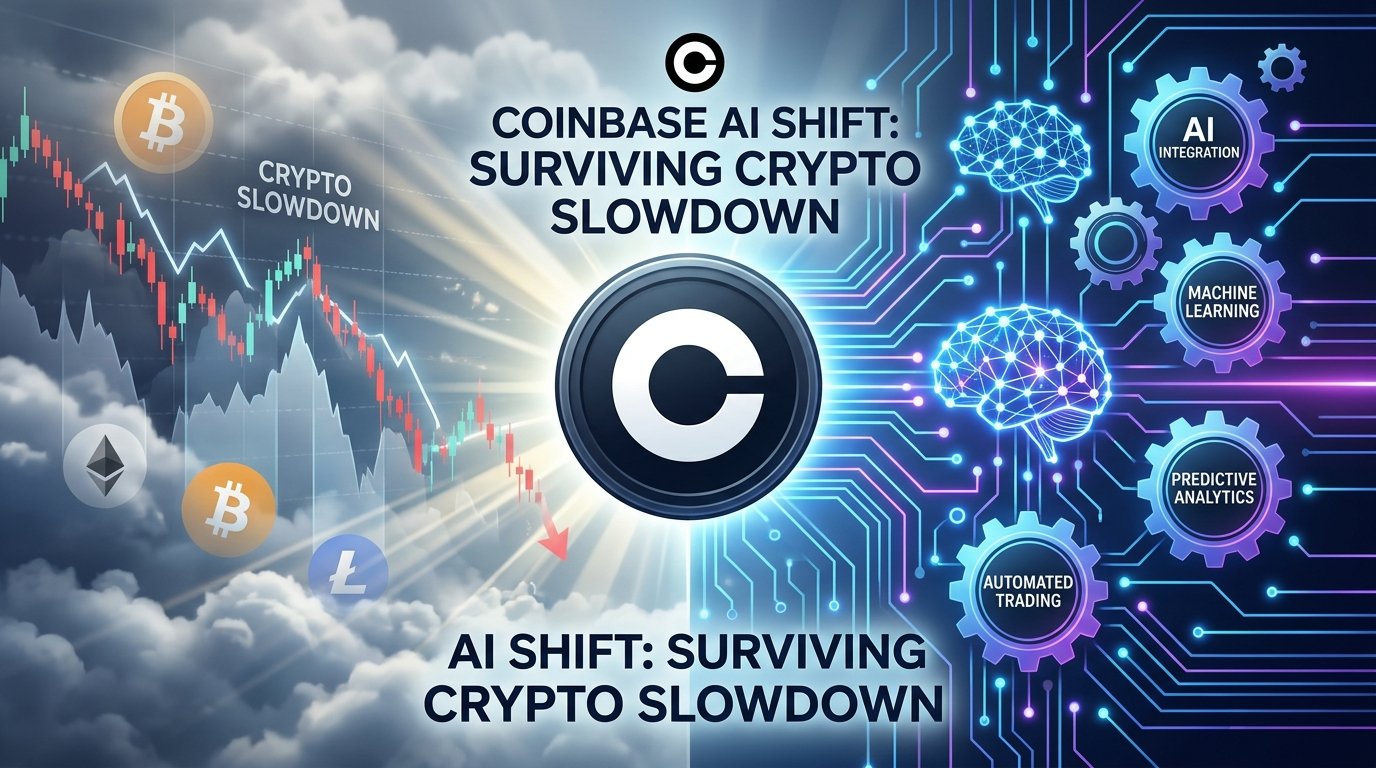
In 2026, Coinbase is undergoing one of its most significant strategic transformations yet—pivoting toward becoming an AI-first company. This shift is not merely a trend-driven move but a calculated response to declining crypto market momentum, rising operational costs, and the emergence of artificial intelligence as a transformative force across industries.
Recent developments highlight this transition clearly. Coinbase announced layoffs affecting roughly 14% of its workforce, citing both crypto market weakness and the need to restructure around AI-powered operations. This signals a deeper shift in how the company envisions its future—leaner, faster, and heavily reliant on automation and intelligent systems.
This article explores in depth why Coinbase is embracing an AI-first strategy, what it means for the broader crypto ecosystem, and how this transformation could redefine the future of digital finance.
The Crypto Slowdown: A Catalyst for Change
Declining Trading Volumes and Market Volatility
The crypto market has experienced cycles of boom and bust, but the recent slowdown has been particularly impactful. Bitcoin and other digital assets have seen fluctuating prices, and investor enthusiasm has cooled compared to previous peaks. This has directly affected platforms like Coinbase, whose revenue heavily depends on trading activity.
Reports indicate that weaker investor sentiment and reduced trading volumes have forced Coinbase to rethink its cost structure and operational model. The slowdown is not just a temporary dip—it reflects a maturing market where easy gains are no longer guaranteed.
Revenue Pressure and Business Model Challenges
Coinbase’s traditional revenue streams—transaction fees and trading services—are inherently cyclical. When trading activity declines, so does revenue. This exposes a fundamental vulnerability in centralized exchanges.
As a result, Coinbase is actively seeking diversification. The integration of AI-driven solutions, automation, and new product offerings is part of a broader effort to stabilize revenue streams and reduce dependency on volatile market cycles.
The Rise of AI in the Tech Industry
AI as a Transformational Force
Artificial intelligence is reshaping industries at an unprecedented pace. From automating workflows to enhancing decision-making, AI has become a cornerstone of modern business strategy.
Coinbase itself has acknowledged that AI is not just an incremental improvement but a fundamental technological shift that will define the next era of innovation. This perspective aligns with broader industry trends where companies are reengineering operations around AI capabilities.
Efficiency Gains and Productivity Boost
One of the most compelling reasons for adopting AI is its ability to dramatically increase productivity. Coinbase CEO Brian Armstrong noted that engineers can now complete tasks in days that previously took weeks, thanks to AI tools.
This level of efficiency enables companies to do more with fewer resources, making AI an attractive solution during periods of economic pressure.
Coinbase’s AI-First Strategy Explained
Transition to “AI-Native” Operations
Coinbase is not simply integrating AI into existing workflows—it is restructuring itself to become an AI-native organization. This means designing processes, teams, and products with AI at the core rather than as an add-on.
The company is experimenting with innovative concepts such as “one-person teams,” where individuals leverage AI tools to handle tasks traditionally performed by multiple departments.
Flattening Organizational Structure
Another key component of Coinbase’s transformation is the elimination of hierarchical layers. By reducing management levels and empowering smaller teams, the company aims to increase agility and speed.
This approach mirrors startup culture, where rapid decision-making and execution are prioritized. It also aligns with AI’s ability to handle routine management and coordination tasks.
Workforce Transformation and Layoffs
The Role of AI in Job Reductions
Coinbase’s recent layoffs have sparked significant debate. While the company attributes these cuts partly to AI adoption, analysts suggest that the reality is more complex, involving cost-cutting and market conditions as well.
Nevertheless, it is clear that AI is reshaping workforce requirements. Roles that involve repetitive tasks or basic analysis are increasingly being automated.
Emergence of AI-Native Talent
As Coinbase shifts toward an AI-first model, the demand for AI-native talent is rising. These are professionals who can effectively use AI tools to enhance productivity and innovation.
This marks a broader trend in the tech industry, where adaptability and technological fluency are becoming essential skills.
AI and Crypto: A Converging Future
The Intersection of Two Disruptive Technologies
The convergence of AI and cryptocurrency represents a powerful combination. Both technologies are decentralized in nature and have the potential to reshape global systems.
Coinbase has emphasized that the integration of AI with crypto is not just a trend but a long-term structural shift that could redefine financial systems.
New Use Cases and Opportunities
AI can enhance crypto platforms in several ways, including:
- Fraud detection and security improvements
- Automated trading and portfolio management
- Enhanced customer support through AI agents
- Smart contract optimization
These innovations can improve user experience while reducing operational costs.
Cost Efficiency and Profitability Goals
Reducing Operational Expenses
One of the primary motivations behind Coinbase’s AI shift is cost efficiency. By automating processes and reducing workforce size, the company can significantly lower expenses.
The restructuring associated with layoffs is expected to cost between $50 million and $60 million in the short term but is aimed at long-term savings.
Building a Sustainable Business Model
An AI-first approach allows Coinbase to create a more resilient business model. By reducing reliance on human labor and increasing automation, the company can maintain profitability even during market downturns.
Competitive Pressure in the Crypto Industry
Staying Ahead of Rivals
The crypto industry is highly competitive, with exchanges constantly innovating to attract users. Coinbase’s AI strategy is partly driven by the need to stay ahead of competitors who are also adopting advanced technologies.
Companies that fail to embrace AI risk falling behind in terms of efficiency, user experience, and innovation.
Industry-Wide Shift Toward Automation
Coinbase is not alone in this transition. Other tech and crypto companies are also leveraging AI to streamline operations and enhance productivity.
This suggests that the move toward AI-first operations is becoming an industry standard rather than an exception.
Risks and Challenges of an AI-First Approach
Over-Reliance on Automation
While AI offers numerous benefits, over-reliance on automation can pose risks. Systems may fail, algorithms may produce biased outcomes, and human oversight remains essential.
Ethical and Workforce Concerns
The shift toward AI raises ethical questions about job displacement and workforce restructuring. As companies reduce headcount, concerns about economic inequality and job security are growing.
Regulatory Uncertainty
Both AI and cryptocurrency are subject to evolving regulations. Navigating this complex landscape will be crucial for Coinbase’s long-term success.
The Long-Term Vision: Coinbase as a Tech-Driven Platform
Beyond a Crypto Exchange
Coinbase is positioning itself not just as a crypto exchange but as a technology platform that integrates AI, finance, and blockchain.
This evolution could open new revenue streams, including AI-powered financial services, institutional solutions, and decentralized applications.
Preparing for the Next Market Cycle
Historically, companies that innovate during downturns emerge stronger in the next growth phase. Coinbase’s AI-first strategy may give it a competitive edge when the crypto market rebounds.
Conclusion
Coinbase’s transformation into an AI-first company is a strategic response to both immediate challenges and long-term opportunities. The crypto slowdown has exposed vulnerabilities in traditional business models, pushing the company to rethink its approach.
By embracing artificial intelligence, Coinbase aims to become more efficient, agile, and resilient. While the transition comes with challenges—including workforce changes and ethical considerations—it also offers significant potential for innovation and growth.
The convergence of AI and cryptocurrency represents a new frontier in digital finance. As Coinbase navigates this shift, it is not just adapting to change—it is actively shaping the future of the industry.
FAQs
Q. Why is Coinbase focusing on AI now?
Coinbase is adopting AI to improve efficiency, reduce costs, and adapt to declining crypto trading volumes. AI enables faster operations and supports long-term growth.
Q. How does the crypto slowdown affect Coinbase?
The slowdown reduces trading activity, which directly impacts Coinbase’s revenue, prompting the company to explore new strategies like AI integration.
Q. What does “AI-first company” mean?
An AI-first company designs its operations, products, and workflows around artificial intelligence rather than using it as a secondary tool.
Q. Will AI replace jobs at Coinbase?
AI is reshaping job roles and reducing the need for certain positions, but it also creates demand for new skills and AI-focused roles.
Q. What is the future of AI in crypto?
AI is expected to enhance security, automate trading, improve user experience, and create new financial products, making it a key driver of future innovation in the crypto space.
